- Published on
Agentic Coding: The Next Iteration of Agent Architecture
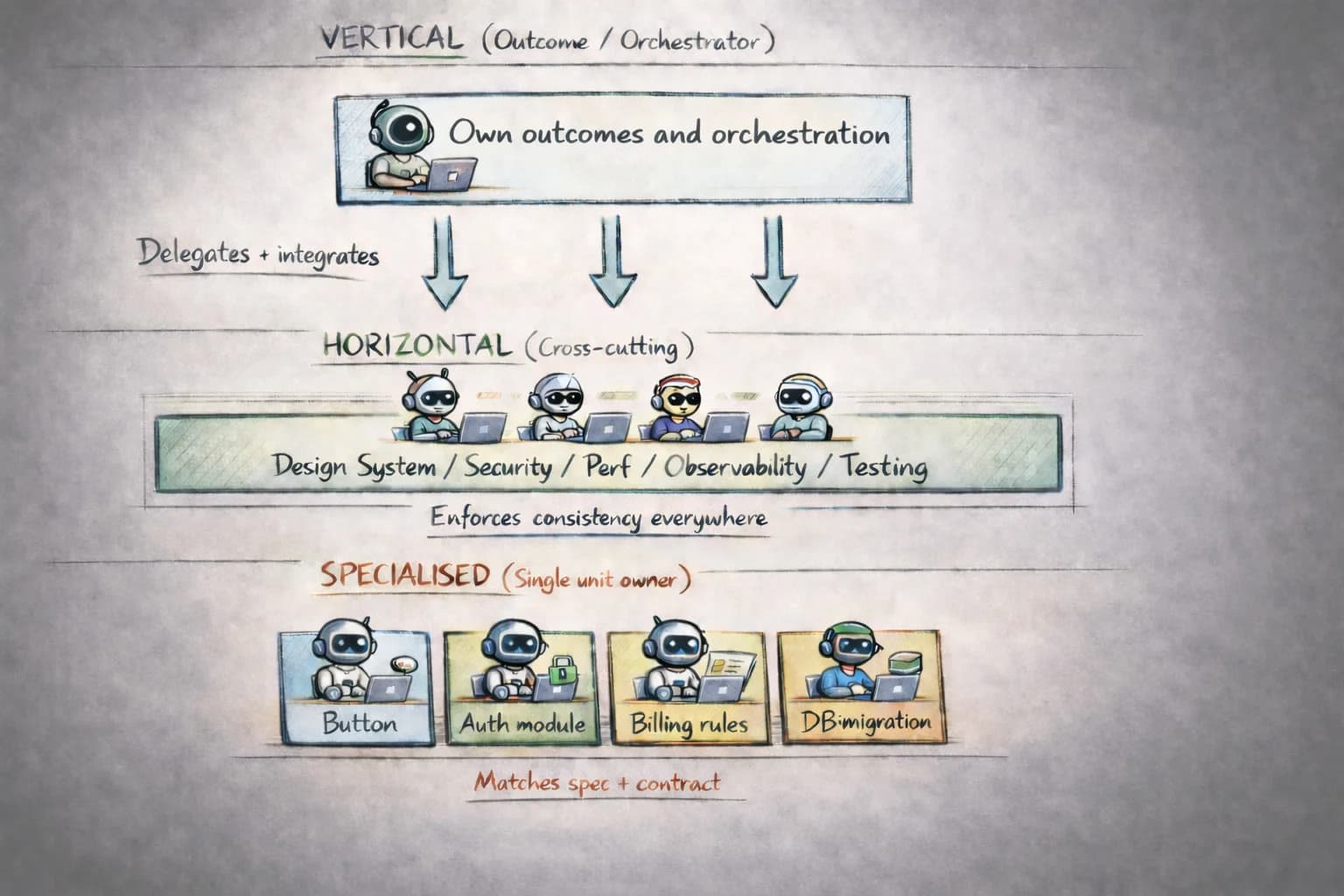
The future is now, software composition becomes agent composition
Software is built from composable units, from components and modules to features and full products. Agentic coding follows the same shape. Instead of one mega frontend, backend, or database agent, we will evolve to use a system of agents with clear boundaries, each optimized for a specific kind of work.
The evolution centers on three kinds of agents:
- Specialised agents, which own one unit
- Horizontal agents, which own one cross-cutting concern
- Vertical agents, which own outcomes and orchestration
1) Specialised agents: single-unit owners
Specialised agents are the smallest, sharpest tools in the toolbox. They focus on exactly one software unit and nothing else.
How to think about them
- A specialised agent is powered by the requirements and spec for one unit.
- Its job is to keep that unit correct, clean, and aligned with its contract.
What they do
- Implement and evolve a single React component or backend module
- Maintain local correctness and internal consistency
- Keep the unit interface stable and predictable
- Produce changes that other agents can integrate easily
Examples
Buttoncomponent agent, covering API, states, accessibility behavior, and testsAuthmodule agent, covering endpoints, logic, and module-level contract behaviorBillingdomain module agent, covering rules, invariants, and migrations
A specialised agent should be able to say:
This component or module matches its spec and its contract is reliable.
2) Horizontal agents: cross-app consistency enforcers
Horizontal agents own concerns that stay consistent across many units, often across the whole codebase.
How to think about them
- They are standards keepers and pattern enforcers.
- They operate across boundaries and prevent drift.
What they do
- Define and enforce conventions
- Review or implement changes that affect multiple areas
- Provide reusable primitives, checks, and guardrails
Examples
- Styling and design-system agent, for tokens, accessibility, and UI consistency
- App-level state agent, for state boundaries and data flow patterns
- Database access agent, for query patterns and migration conventions
- Performance agent, for hot paths, caching, and runtime efficiency
- Security agent, for authorization patterns and sensitive data handling
- Observability agent, for logs, metrics, and tracing standards
- Testing and QA agent, for regression safety and reliability strategy
A horizontal agent should be able to say:
This matches our standards everywhere, not just in one place.
3) Vertical agents: domain owners and orchestrators
Vertical agents are responsible for shipping outcomes. They understand the domain, the requirements, and end-to-end behavior.
How to think about them
- They translate what the team needs into coordinated work.
- They are primary decision-makers for tradeoffs and integration correctness.
- They orchestrate and own outcomes.
What they do
- Understand domain flows, user journeys, business rules, and constraints
- Understand the stack, architecture, and team preferences
- Break work into units and delegate
- Integrate, validate, and declare the feature done
A vertical agent should be able to say:
This feature is done, integrated, and works in the real app.
How they work together
Think of vertical agents as project leads, specialised agents as unit builders, and horizontal agents as the quality and consistency layer.
Typical flow
- A vertical agent reads requirements and defines the outcome and approach.
- The vertical agent delegates to specialised agents for isolated unit work and to horizontal agents for cross-cutting correctness.
- The vertical agent integrates and validates end-to-end behavior.
Interface-first handoffs create compounding speed
One pattern makes this model stronger over time. Every handoff should include an explicit contract, a test signal, and a clear definition of done. When specialised and horizontal agents publish these signals consistently, vertical agents integrate faster with less ambiguity. This does not replace good engineering judgment, but it gives teams a shared language for quality that scales with complexity.
Where this leads
Agentic coding becomes less about one agent that does everything and more about division of labor with clean interfaces:
- Specialised agents maximize depth and correctness within a unit.
- Horizontal agents prevent fragmentation and keep the system coherent.
- Vertical agents ensure outcomes ship and everything works together.
That is how real software teams scale, and agent systems will scale in the same direction.
FAQ
What is agentic coding in practical terms?
Agentic coding is a way of building software where multiple agents share work through clear responsibilities and contracts.
Why is one general purpose agent not enough for large products?
Large products need depth in specific units, consistency across the codebase, and coordinated delivery of outcomes. One agent rarely sustains all three at high quality.
How do specialised and horizontal agents avoid overlap?
Specialised agents own one unit and horizontal agents own one cross-cutting concern. Their interfaces and review rules define where each responsibility starts and ends.
What does a vertical agent own?
A vertical agent owns end-to-end delivery. It breaks work down, delegates to other agents, integrates changes, and validates that the feature works in real usage.
How can a team adopt this model without a full rewrite?
Start with one feature area, define clear contracts, and introduce one specialised, one horizontal, and one vertical role. Expand once the workflow proves reliable.
What will improve first after adopting this architecture?
Teams will usually see faster integration, fewer cross-team regressions, and clearer accountability for quality and delivery.