- Published on
AI to Human Consultation, Not Handoff
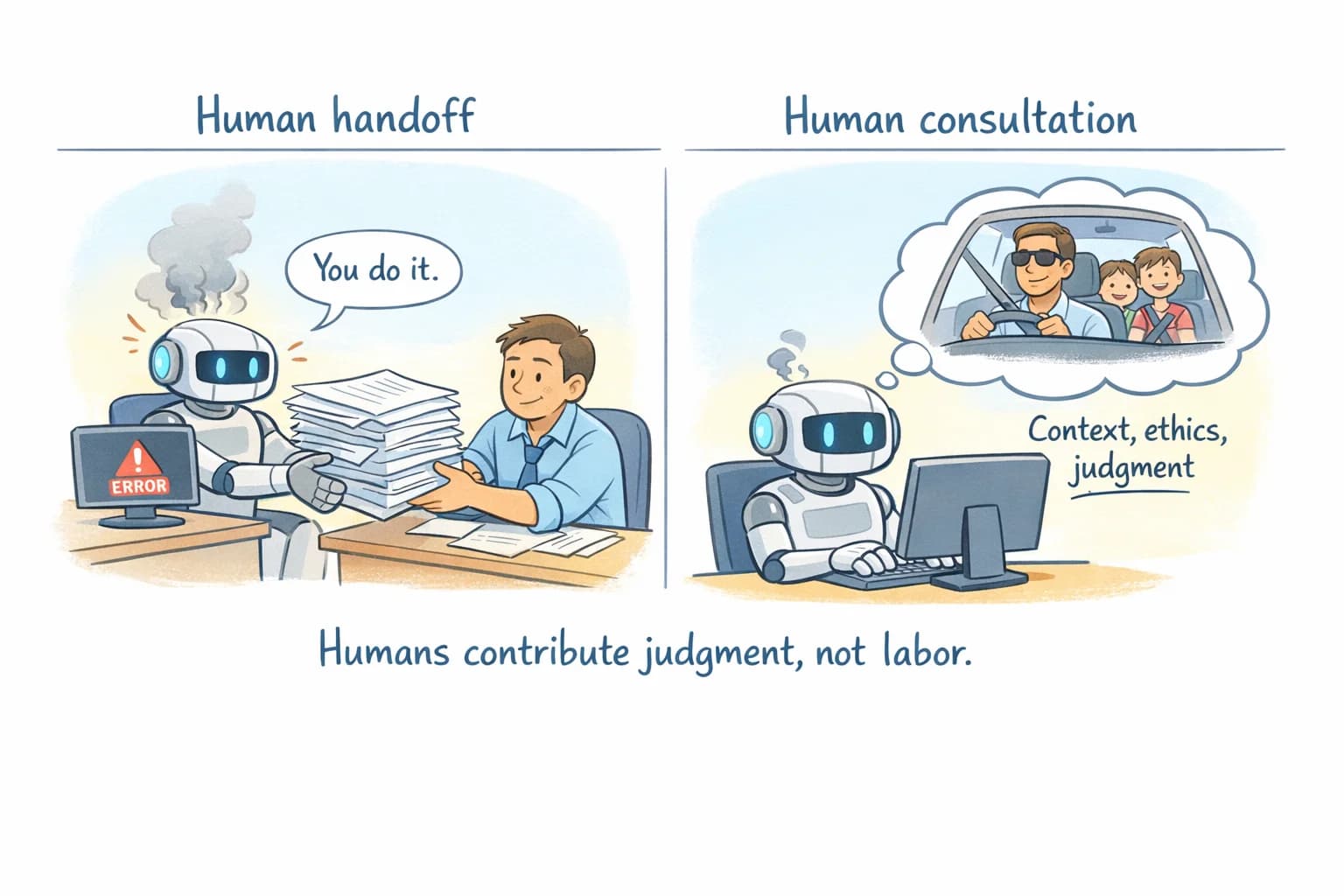
Traditional AI support systems often rely on human handoff when the AI cannot resolve a request. The conversation moves from AI to a human agent, which interrupts continuity and resets momentum for the user.
At Predictable Dialogs, we introduce an AI to Human Consultation Layer that keeps the experience connected and collaborative. Instead of replacing the AI, teams support the AI with targeted expertise.
In this architecture, the AI remains the primary interface while consulting humans in the background when extra expertise, approval, or clarification is needed. The human does not take over the conversation. The AI collects input and continues guiding the user.
This model keeps the experience seamless and helps organizations scale with care, speed, and accountability.
Key Concept
Human handoff
- AI transfers the conversation to a human
- Human becomes the primary interface
- AI exits the interaction
Human consultation
- AI remains the conversational interface
- AI consults humans in the background
- AI gathers human input and responds to the user
- Conversation ownership stays with AI
The operating model shifts from AI escalation to AI-orchestrated consultation.
When Consultation Is Triggered
The system may initiate consultation when:
- AI confidence in a response is low
- The user expresses dissatisfaction or negative sentiment
- The request needs human approval, such as refunds or policy overrides
- The AI lacks required business context
- The situation involves risk, compliance, or legal judgment
- The request relates to a high-value or priority customer
The AI decides whether to:
- Answer directly
- Consult a human in the background
- Escalate to full human takeover in rare situations
Solution Architecture
The AI Consultation System includes these core components:
1. Conversation Layer
Handles user interactions across web chat, mobile apps, messaging platforms, and voice interfaces. Maintains conversation context and generates responses.
2. Consultation Decision Engine
Determines whether consultation is needed using signals such as confidence scores, sentiment detection, business rules, and policy requirements.
3. Consultation Orchestrator
Manages how consultation happens, including:
- Identifying the right expert or team
- Selecting communication channels
- Managing escalation logic
- Tracking response timeouts
4. Human Reachability Channels
Consultation requests can be delivered through multiple channels:
- messaging platforms (e.g., WhatsApp, Telegram)
- collaboration tools (e.g., Slack, Teams)
- email notifications
- voice calls
- internal dashboards
The system can contact several channels and use the first response, or escalate sequentially when no response is received.
5. Human Consultation Interface
Humans receive a concise summary that includes:
- The user request
- Conversation context
- The specific question that needs consultation
They respond with guidance, approvals, or clarifications.
6. Response Interpretation Layer
Processes human responses, extracts relevant information, and converts it into structured input for the AI.
7. Response Synthesis Layer
The AI integrates human input into a clear response and continues the conversation with the user.
Example Flow
- A user asks a complex question.
- The AI attempts to answer and detects low confidence.
- The Consultation Decision Engine triggers human consultation.
- The Consultation Orchestrator contacts a relevant expert through messaging.
- The human receives a summarized issue and provides guidance.
- The system interprets the response.
- The AI delivers the final answer to the user.
From the user perspective, the conversation stays continuous with the AI.
Benefits
Seamless user experience
Users stay with one interface and do not need to repeat context.
Efficient use of human expertise
Humans are consulted when needed instead of taking over full conversations.
Faster resolution
The AI keeps moving the interaction forward while human input is gathered.
Operational flexibility
Teams design consultation workflows across channels and escalation paths.
Better scalability
AI handles routine interactions while humans focus on high-impact judgment.
Strategic Value
The AI Consultation System turns AI from a simple automation layer into an orchestrator of human expertise.
Instead of building systems where AI fails and humans take over, organizations can build systems where AI continues the interaction and consults humans at the right moment. This approach supports both scale and service quality, and it helps teams serve people with consistency and care.
A practical example of this direction is Manushya, where this AI-human consultation model is being implemented with AI staying in the conversation while humans provide judgment behind the scenes.
You can read more about the architecture of the AI to Human Consultation Layer.
Frequently Asked Questions
What is the difference between human handoff and human consultation?
In a handoff, a human agent takes over the conversation. In consultation, the AI remains the main interface and brings in human guidance in the background.
Why does this model improve user experience?
Users stay in one continuous conversation, so they avoid channel switches and repeated context sharing.
When should the AI ask for consultation?
The AI asks for consultation when confidence is low, approvals are required, or risk and policy judgment are involved.
Does consultation replace human agents?
No. Consultation makes human expertise more focused by involving people in the moments where judgment matters most.
How do teams receive consultation requests?
Teams can receive requests through messaging tools, collaboration platforms, email, voice calls, or internal dashboards.
Can this model support regulated workflows?
Yes. Consultation paths can include policy checks, approval gates, and audit-friendly records for sensitive decisions.
What happens if no human responds in time?
The orchestrator can retry through other channels, follow escalation rules, and move to fallback actions based on policy.
How does this model help teams scale responsibly?
AI handles routine interactions while humans provide high-value guidance, which improves service quality without losing human oversight.