- Published on
Who Wins When Everyone's Writing Code
- Authors

- Name
- Jai
- @jkntji
OpenClaw became so popular that some people even said Mac mini sales went up. That was a useful signal, people were willing to spend when the tool felt genuinely promising.
At the same time, the amount of code being generated right now is massive. But code only creates value when it is deployed and actually used, not deployed once and then forgotten.
One way to make sense of what is happening is to think of software in three layers:
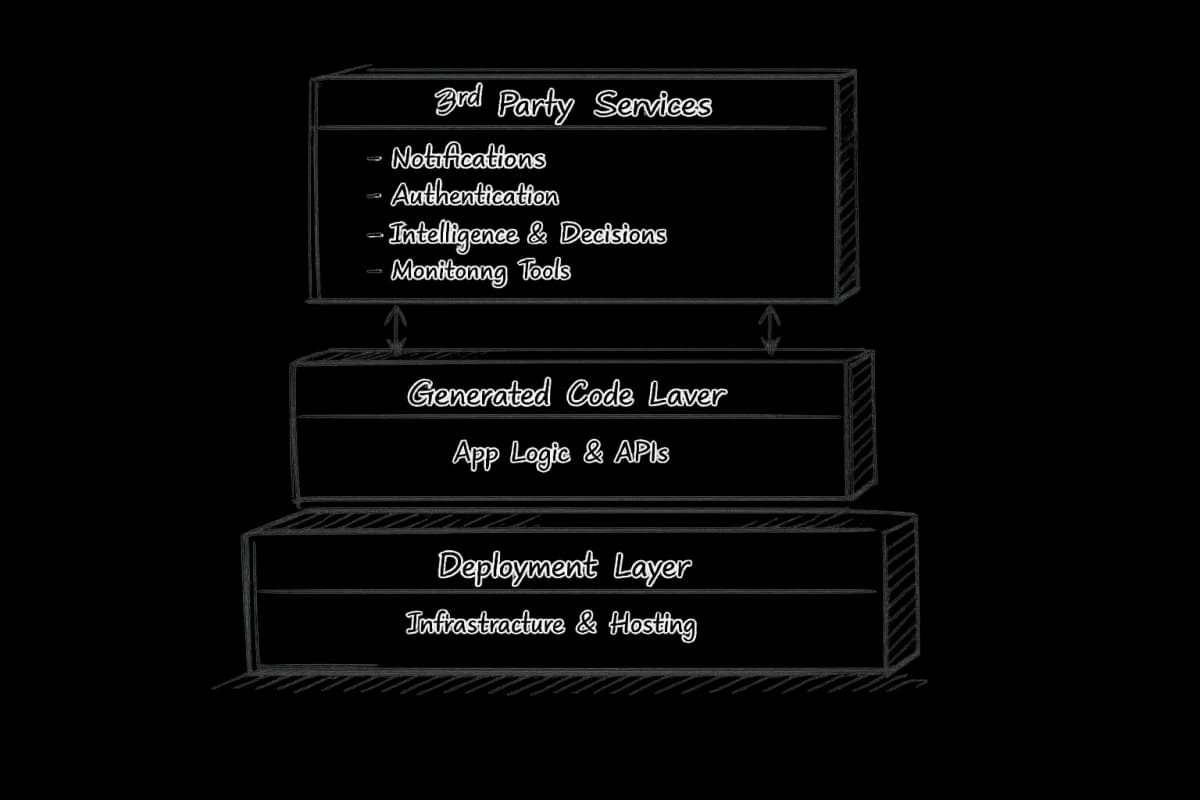
- Layer 1: Deployment (hosting, pipelines, releases, uptime)
- Layer 2: Generated code (the app logic created quickly)
- Layer 3: Third-party capabilities (auth, notifications, monitoring, intelligence and decisions)
My main takeaway from OpenClaw is that we will likely see strong growth in companies building Layer 1 (deployment) and Layer 3 (capabilities). Recent earnings data supports this direction.

Predictable Dialogs lets you train ultra-fast AI chatbots on your documents. Embed with a simple copy-paste snippet, or integrate via JS, React, or Next.js.
Why Layer 1 Will Grow
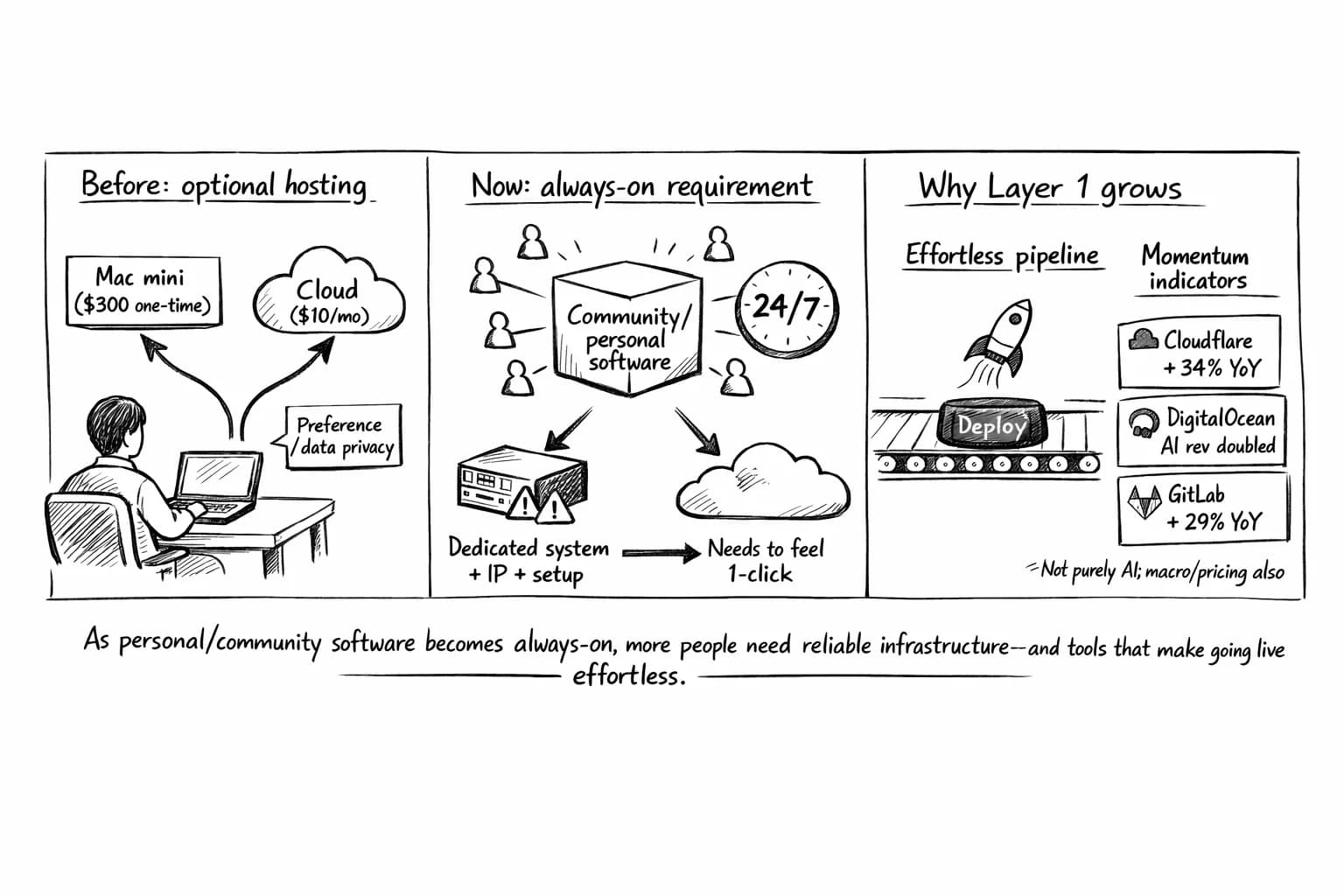
Before, many people could either run OpenClaw locally, for example on a Mac mini, or host it in the cloud. That choice often came down to personal preference, a one-time ~$300 purchase vs. ~$10/month in the cloud, or a simple concern like "I do not want my data in the cloud."
Either way, more people will need a dedicated system somewhere to run their software reliably.
We are entering an era where people create software for themselves and for the communities they care about. Once that happens, software will need to stay available 24/7. If someone self-hosts, they may also need a dedicated IP and additional setup, which adds cost and complexity. If a meaningful percentage of users chooses the cloud, then the pipeline from "code exists" to "software is live" will need to feel incredibly simple.
That is why I expect more tools that make deploying personal or small-scale software feel effortless. The deployment players also reported momentum. Cloudflare grew 34% YoY in Q4, and management explicitly attributed rising demand to "AI and agents." DigitalOcean, which now calls itself an "agentic cloud," reported that its direct AI revenue doubled year over year. GitLab, which frames AI as a delivery requirement under its "deliver secure software faster" positioning, grew 29% YoY. These are real companies reporting real numbers, though strong macro tailwinds and pricing changes also played a role, and none of them cleanly isolated AI code generation as the sole driver.
Why Layer 3 Will Grow
People want to write code for their specific app, not rebuild the entire stack every time. They do not want to re-implement auth, notifications, monitoring, and decision or intelligence layers from scratch.
As generated software (Layer 2) expands, powered by tools like Codex, cloud code workflows, and Cursor, demand will increase for the services around it, both the layer below (deployment) and the layer above (capabilities that make apps production-ready and useful).
Layer 3 numbers also moved in that direction. Datadog grew 29% YoY in Q4 and framed its platform as observability and security for production AI apps. Okta grew 13% YoY, with identity increasingly treated as a core reusable capability rather than something teams built themselves. Twilio, which explicitly calls itself "foundational infrastructure in the age of AI," grew 14% YoY.
A less obvious opportunity will emerge between Layer 1 and Layer 3, integration and governance glue. As more generated apps reach production, teams will need default patterns for identity, logging, rate limits, and rollback that work out of the box. The winners will make safe operations feel almost as easy as generating the first commit.
If Layer 2 keeps booming, Layers 1 and 3 will become the picks and shovels. These numbers do not prove causality, but they are consistent with the thesis.
Frequently Asked Questions
Why does deployment demand increase when more people generate code?
More generated projects will still need hosting, release pipelines, uptime, and clear operational workflows. The easier code creation becomes, the more important reliable deployment becomes.
What counts as Layer 3 capabilities?
Layer 3 includes reusable services like authentication, notifications, monitoring, and decision support. These capabilities let builders focus on what makes their product unique.
Do company growth numbers prove AI causes all of this demand?
No. They are directional indicators, not proof of direct causality. Pricing changes and broader market forces also influence results.
What bottleneck appears after code gets easier to generate?
Operational trust will become the bottleneck. Teams will need clear observability, policy controls, and rollback paths so generated apps stay dependable.
How should builders act on this trend?
Move quickly in Layer 2, then invest early in Layer 1 and Layer 3 so your software remains reliable, secure, and useful for real people.