- Published on
Why human handoff is a bad idea
At Predictable Dialogs, we intentionally do not support traditional handoffs.
That decision is deliberate. We believe handoffs are not the best way to use AI systems well. Over time, many users asked for handoff capabilities. We listened carefully, and we still chose a different path because the standard solution limits what AI can deliver.
Technology changes quickly, and product choices cannot come only from familiar patterns. Handoffs are common in chatbot products, so our position can sound unusual. We are not rejecting customer needs. We are solving them in a more durable way. If the goal is to fully leverage AI, the answer is not moving a conversation from AI to a human. The better model is human consultation. Predictable Dialogs is building human consultation into its products.
While the market asked for handoffs, we built toward a model aligned with the future of AI systems.
Human handoff is a fallback. Human consultation is the model.
When people talk about human handoff in AI conversations, they usually mean the AI stops interacting with the user and the conversation moves to a human agent. We can do better than that.
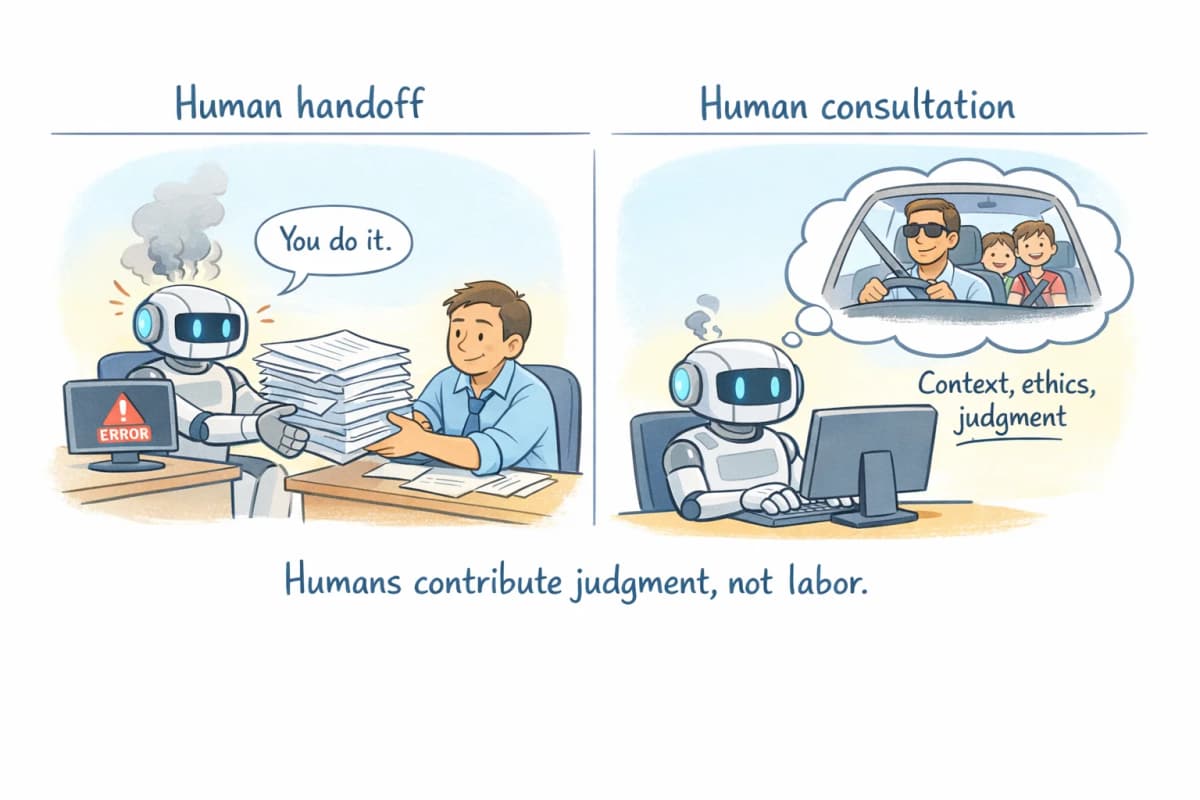
Our strategy is:
Do not design for "AI fails, then human takes over." Design for "AI continues, but consults humans when needed."
This architecture is stronger because it preserves user continuity, uses human expertise efficiently, and gives AI a meaningful operational role beyond simple routing.
Imagine a user interacting with an AI assistant. At some point, the AI may not have the right answer, or the user may be dissatisfied. The system can detect this through explicit requests, sentiment signals, or low confidence.
Typically, this triggers a human handoff. The system transfers the conversation to a human working through a dashboard. The implementation is straightforward:
- The system sends a message to a human agent.
- Once the human replies, the response is routed back to the user.
These workflows are procedural and do not require AI. Standard software logic and routing rules can handle them.
Where AI becomes truly valuable is a different model. Instead of transferring the conversation, the AI consults a human in the background while continuing to interact with the user.
In this model, the AI remains the interface with the customer. When additional expertise is needed, the AI reaches out to a human by messaging or voice for clarification or guidance. The AI gathers the guidance and communicates the final answer back to the user.
From the user perspective, the conversation never leaves the AI assistant. The AI acts as the intermediary that consults humans when necessary.
This approach has several advantages:
- The user experience remains seamless and uninterrupted.
- Human expertise is leveraged when needed.
- AI orchestrates the consultation process intelligently instead of simply transferring the conversation.
- Humans do not need to sit at a fixed desk, and AI can reach the right expert through multiple channels.
We believe human expertise deserves a better role. Human handoff was a workaround. Human consultation is the real innovation.
Humans contribute judgment, not labor.
AI is not essential for simple routing tasks like:
- send message to WhatsApp
- forward human response
Code and workflow rules can do that.
AI becomes essential when the system must:
- detect that consultation is needed,
- understand why it is needed,
- frame the right question to the human,
- summarize the user issue clearly,
- interpret natural language human replies,
- ask follow up questions,
- and convert the consultation result into a coherent user response.
That is the difference between adding humans to a chatbot workflow and building an AI system that can operate in the real world.
A consultation model treats AI as the primary interface and humans as experts the system can draw on when necessary. AI stays responsible for continuity, context, and response quality. Humans contribute judgment, not labor.
You can read more here on how AI to human consultation works.
Frequently Asked Questions
Why is human handoff a weak default for AI assistants?
Handoff treats AI as a temporary filter. Consultation keeps AI as the continuous interface, so users keep context and get faster answers.
What does human consultation mean in practice?
The AI keeps the conversation with the user and reaches a human expert in the background when extra judgment is needed.
Does this model replace human experts?
No. It gives human experts a focused role where they provide judgment and guidance while AI handles continuity and delivery.
How does the AI decide when to consult a human?
The system uses signals such as low confidence, explicit user requests, and response quality checks to trigger consultation.
Can small teams use consultation without a call center setup?
Yes. AI can contact the right person across channels, so experts can contribute without sitting at a fixed support desk.
What outcome does this approach create for customers?
Customers get a steady conversation, faster resolution, and clearer answers without being moved between disconnected systems.